Craft Brewery Equipment Buying Guide
Capacity on a brewery supplier's website is quoted in whatever unit that page uses: litres, hectolitres, barrels or tonnes. HGMC publishes everything from 100 L to 200 T and from 1 BBL to 100 BBL, and the first job of a buyer is to convert those figures into one unit before comparing anything.
Key takeaways
- Convert everything to litres before comparing: 1 BBL is about 117 L, 1 HL is 100 L, and a tonne-class figure is roughly 1,000 L.
- The published ladder runs from a nano brewery of 5 BBL or less, through a microbrewery producing 18,000 barrels a year or less, to micro craft systems of 1,000-3,000 L and large commercial plant up to 100 HL.
- A complete 10 BBL system is published at around US$75,000-200,000, with valves, pipes and a steam boiler named as the items that move the figure.
- Delivery is published at 90-150 days from deposit to door delivery, so the equipment choice is also a scheduling decision.
Read Every Figure With Its Unit
The same plant can be described four ways. A 2,000 L brewery is a two-hectolitre plant, roughly 17 barrels, and a little over two tonnes of capacity; a quotation that mixes those units without saying so is not lying, but it is making comparison harder than it needs to be. Fix a single unit for your own planning — litres is the safest — and convert every figure you are shown into it before you write anything down.
It also helps to know which unit a supplier reaches for. Big commercial plant is usually described in hectolitres because 100 HL reads more cleanly than 10,000 L. Barrels appear most often in English-language craft brewing, where a 10 BBL brew length is a familiar landmark. Tonnes appear on larger Chinese-built systems, where a 20 T or 50 T unit is a shorthand that has to be converted before it can be compared with anything bought in the United States. This manufacturer goes further than most and offers what it calls a Brewery/Distillery/Winery All-In-One Solution, which is a fair description of a catalogue that covers beer, wine, cider and kombucha vessels under one roof.
The Published Ladder From 100 L to 200 T
HGMC publishes a ladder rather than a single size. At the small end sits the nano brewery, 5 BBL or less, which takes little space and suits a taproom or a restaurant. Above it is the microbrewery, described as producing 18,000 barrels or less a year. Then comes the micro craft system at 1,000-3,000 L, the band where most new craft breweries actually start, followed by large commercial equipment running up to 100 HL.
Published overall capacity spans 100 L to 200 T, and the equipment itself is offered from 1 BBL to 100 BBL, with another page describing a range from a half barrel up to more than 17 BBL and large commercial systems up to 100 HL. Those numbers are not in conflict; they are the same catalogue described at different scales, and reading them as a ladder rather than a contradiction is the difference between a confused buyer and a decisive one.
What the Scope Contains at 10 BBL
The published example bill of materials for a 10 BBL system is the most useful document on the site, because it turns a price range into a list. It names a 10 BBL mash/lauter tun, a 10 BBL kettle/whirlpool tun with steam heating, a 20 BBL hot water tank, a 3 m3 wort pump and hot water pump, stainless steel 304 wort pipes, a 10 m2 plate heat exchanger, an operation platform, four 10 BBL fermentation tanks, a glycol water tank, a chiller, cooling pipes and valves, a CIP unit and a control cabinet with a semi-automatic control system.
Read that list twice, because it explains the price range. The published cost of around US$75,000-200,000 for a complete 10 BBL system is wide for a reason the same page states plainly: valves, pipes, steam boiler and other requirements change the figure. Two buyers can order the same four fermentation tanks and end up US$80,000 apart because one of them needed a boiler, a longer pipe run and a fully automatic panel.
Control Level, Fabrication and Support
Control is the second largest variable once scope is fixed, and it arrives in three grades. At the entry level sits a PID display panel; above that, a PLC touch screen running semi-automatically; at the top, a fully automatic PLC panel that indicates the curve and prints a production record. The automatic grade is not about prestige so much as repeatability between shifts and a written trace of what the mash and the wort actually did.
Fabrication detail is published too: TIG 100% full welding joints, polishing accuracy of 0.4 micrometres or better, stainless steel 304 or 316 plate in 3 mm and 2 mm thicknesses, and SUS304 food-grade material certified by SGS. Support runs alongside: installation, commissioning, operator training, maintenance and spare parts, free 2D, 2.5D and 3D design for space layout and piping, a 6-year warranty on tank accessories and electronic components against manufacturing defects from the factory when used within scope, and 24/7 sales availability.
| Published class | Quoted as | What a buyer normally does with it |
|---|---|---|
| Nano brewery | 5 BBL or less, about 585 L | Taproom or restaurant production, brewed beside the bar in a small footprint |
| Microbrewery | 18,000 barrels a year or less | A regional craft brewery with a wholesale book and a distribution van |
| Micro craft system | 1,000-3,000 L | The start-up band: enough brew length for kegs and cans without a second building |
| Large commercial | Up to 100 HL, about 10,000 L | Municipal-scale plant with a full packaging line and dedicated utilities |
| Overall site range | 100 L to 200 T, roughly 200,000 L at the top | The whole ladder, from pilot kit to a tank farm with 20 T-50 T hot products |
Worked example
The conversions below are a worked example for comparison purposes, using the brewing convention of 1 BBL = 117 L, 1 HL = 100 L and a tonne-class figure of roughly 1,000 L. They are arithmetic, not quotations, and they assume a single-unit project rather than a multi-tank farm.
Start with the awkward one: the published reference to a setup of more than 17 BBL. At 117 L per barrel, 17 x 117 = 1,989 L, so a 17 BBL plant brews just under 2,000 L a turn and sits inside the published micro craft band, whose ceiling of 3,000 L works out at 3,000 / 117 = 25.6 barrels. That single conversion tells you whether a supplier is quoting you a start-up system or something twice the size.
Now the top of the ladder. Large commercial plant up to 100 HL is 100 x 100 = 10,000 L, which is 10,000 / 117 = 85.5 barrels per turn. The overall published ceiling of 200 T is roughly 200,000 L at about 1,000 L per tonne, or 200,000 / 117 = 1,709 barrels. Between the nano floor of about 585 L and that ceiling, the published range spans roughly 340 times, which is why any comparison has to be made at one scale.
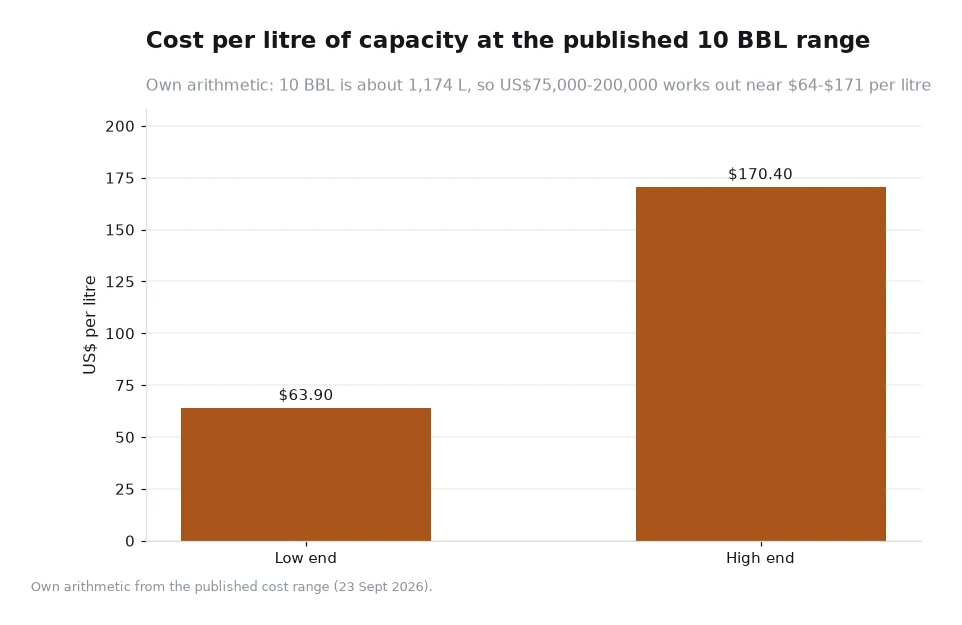
Finally, the cost arithmetic that ties a published range to a production plan. Divide the US$75,000-200,000 example by the 1,174 L of a 10 BBL brew length and the answer is 63.9 per litre at the bottom of the range and 170.4 at the top; divide the same totals by the ten barrels instead and they give US$7,500 to US$20,000 per barrel, which is the figure that belongs beside a weekly production plan rather than beside another quotation.
Frequently asked questions
How should I read the capacity ranges on a brewery equipment website?
Read each figure with the unit it is published in, then convert. This manufacturer quotes 100 L to 200 T overall, equipment from 1 BBL to 100 BBL, large commercial plant up to 100 HL and hot products at 20 T-50 T, so convert everything to litres first: 1 BBL is about 117 L, 1 HL is 100 L and a tonne-class figure is roughly 1,000 L.
What does a complete 10 BBL brewery cost?
The published example is around US$75,000-200,000 for a complete 10 BBL system, with the note that valves, pipes, a steam boiler and other requirements change the figure. The range is wide because scope varies between projects, not because the vessels themselves vary that much.
Turning the Ladder Into a Shortlist
Pick the class first from the published ladder, then read the bill of materials for that class line by line and mark what your site already has. A boiler, a longer pipe run or a fully automatic panel is what separates the bottom of a price range from the top, and none of those three line items is hidden once you know to look for them.
The brewery-system pages carry the published cost example and bill of materials, the beer brewing range covers vessels, filling and CIP, and the micro craft systems are the band most new breweries buy first.
Finally, size the order to the third year rather than the first. HGMC has shipped to more than 120 countries and works in compliance with the ISO9001:2015 quality management system, so its engineers are used to buyers who arrive with a growth plan; the same conversation that fixes today's brew length can also reserve the floor space and the electrical supply for the next size up.
Published figures in this article come from the manufacturer's own website (hgmcbrewing.com), read 23 Sept 2026: the capacity classes, the 10 BBL bill of materials and cost range, the control levels, the fabrication specifications, the 6-year warranty on tank accessories and electronic components against manufacturing defects, and the 90-150 day window from deposit to door delivery. All conversions and per-litre or per-barrel cost figures are the author's own arithmetic.[1]