From Yen Bai to Rotterdam: How Vietnamese Panels Reach Europe
A panel that leaves a press in northern Vietnam and lands on a Rotterdam site has already cleared four gates: veneer selection, glue mixing, hot pressing and export paperwork. The mill on that route publishes 48,000 m² of factory area, 16+ automated lines and a monthly supply ceiling above 100 × 40ft, so most of the checks can be made before the first email is written.

Key takeaways
- Factory area is published as 48,000 m², with a warehouse of more than 3,000 m² behind it.
- Standard formats run 1500 × 3000 mm at the top, 1250 × 2500 mm in the middle, 1220 × 2440 mm at the base, plus custom sheets up to 1830 × 3830 mm.
- the company pages name six schemes — ISO, CE, SGS, FSC, EUDR and BSCI.
- Four-week capacity example: 100 × 40ft ÷ 4 = 25 containers per week.
Why the pressing happens near the plantation
Yen Bai Province sits in the plantation belt of northern Vietnam, which is why peeling, drying and pressing can be handled at one location instead of being split across three suppliers. The company has been running since 2009 and describes 30+ years of accumulated manufacturing expertise behind the current site.
For an importer, the practical effect is moisture control. Veneer dried and pressed inside the same 48,000 m² footprint does not take a second transport leg before it reaches the glue line, and the mill tests panels in its own laboratory from raw material intake through to the export batch.
What a European buyer can confirm from a desk
Anyone can take a stand at a trade fair under the heading Plywood Supplier, so the fastest filter is capacity that has been published rather than promised. Every figure in the table below appears on the company's own pages and can be checked in a single sitting, without a factory visit.
| Item | Published value |
|---|---|
| Production floor | 48,000 m² |
| Storage building | Over 3,000 m² |
| Automated lines | 16 or more |
| Capacity each month | Above 100 × 40ft |
| Countries served | More than 170 |
Certification, duty position and the EUDR file
European buying teams now separate certificates they can file from claims they cannot. The named schemes are ISO, CE, SGS, FSC, EUDR plus BSCI; the home page adds CARB P2 and E0/E1 glue classes for emission performance. CE documentation is what supports most of the construction and interior uses that European importers buy for.
Watch how a supplier describes the scheme list. Six names on a page tells you which documents exist, not which products carry them, and the difference matters when your compliance team asks for evidence on one specific line. Ask for the certificate that matches the goods you are buying — the panels in the order, not the company in general.
Duty exposure is the second file. The company positions itself around 0% anti-dumping duties for the EU and US markets, which changes landed cost arithmetic in a way that a line of discount on the invoice does not. Where a supplier describes itself as EUDR-ready, ask for the due-diligence statement that ties a consignment back to its supply area, and treat that as a document request rather than a slogan.
Sizes and thicknesses that survive a long sea route
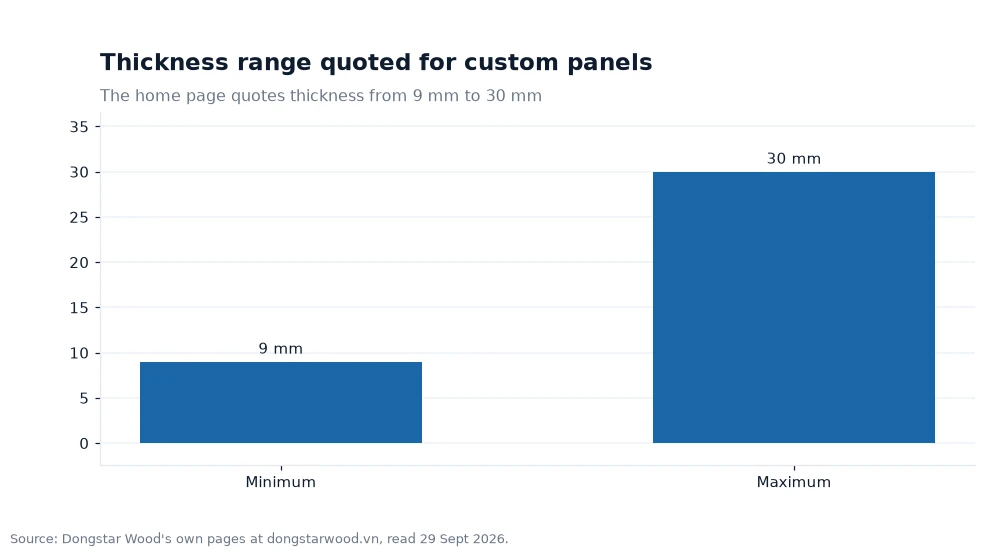
The home page quotes thickness from 9 mm toward 30 mm, alongside custom panels up to 1830 × 3830 mm. Standard formats cover formats 1500 × 3000 mm and 1220 × 2440 mm, with 1250 × 2500 mm as well, which is the range most formwork and furniture drawings are already set to.
Staying inside the standard range keeps packing simple: export-standard wrapping, steel strapping and wooden pallets are the stated method, and custom packaging and labelling are offered for larger programmes. Sheets cut to a project size reduce waste at the other end, but they also take a longer production slot, so fix the format before the proforma is issued.
Weight is the last consideration, and the easiest to forget. A 30 mm panel at 1830 × 3830 mm is not a sheet anyone moves by hand, so the handling plan — crane, vacuum lifter or a smaller format — should be agreed at the same time as the specification rather than worked out on arrival.
Thickness deserves the same care. A 9 mm board and a 30 mm board travel in the same container and are quoted by the same mill, but they belong to different projects: light cabinet work at one end, heavy structural panels at the other. Mixing both into one shipment is normal, and it is worth asking how the pallets will be separated so the site team can tell them apart without opening every bundle.
How a first order usually gets scheduled
Most importers open with a trial lot built around a live project, then widen the specification once flatness and edge quality have been checked on site. Capacity above 100 × 40ft per month means a trial can sit comfortably inside one month of output. It also means the second order can be booked against the same line rather than a substitute one.
Ask which of the 16+ lines the trial will run on. A mill that answers that question in writing is telling you the order was scheduled rather than squeezed into whatever capacity happened to be free that week, and the answer is the difference between a supplier and a trading desk with a good website.
Two checks that are easy to skip
The first is flatness measured after the sea leg, not at the loading gate. Wrapping, strapping and pallet construction are all published details, but the only way to know how a board behaves after six weeks in a container is to open one on arrival and set it against the sample that started the order.
The second is the glue class on the export documents. A quotation that names WBP or Phenolic Dynea while the shipping file does not is a specification that was never written down. Match the two before releasing the balance, and keep the batch reference with the certificate set — ISO, CE, SGS, FSC, EUDR and BSCI documents are useful only when they can be traced back to the panels in front of you.
Worked example: from monthly capacity to a container rhythm
Published capacity is the easiest number to put to work. Take the stated 100 × 40ft per month and divide by four weeks: 100 ÷ 4 = 25 containers per week (example). A programme shipping six containers a month therefore occupies roughly one week of output in four.
Sheet area turns the same figures into panel volume. Take the 1500 × 3000 mm format: 1.5 × 3.0 = 4.5 m², while the custom maximum of 1830 × 3830 mm is 1.83 m × 3.83 m = 7.01 m². A project needing 900 m² of shuttering face is 900 ÷ 4.5 = 200 sheets in the 1500 × 3000 mm format (example).
Frequently asked questions
What should a European importer request first?
Start with the certificate list rather than a price list. Six schemes are named on the company pages, and the follow-up question for each is whether you can see the certificate itself instead of a logo: ISO, CE, SGS, FSC, EUDR and BSCI each cover a different part of the chain.
Which thickness should a first order specify?
For concrete work, 18 mm is the standard heavy-use choice and 21 mm and above suits bridges and high-load platforms. Furniture programmes usually settle on 12 mm and 18 mm, the two sizes contractors most often standardise on across a whole project.
How does EUDR change a quotation?
It moves the conversation to documentation. A supplier that markets itself as EUDR-ready should be able to explain how a consignment maps back to its supply area, and that explanation belongs in the file next to the CE documentation and the declared glue class.
Following the route one step further
Specification sheets are the shortest way to see what travels: set the panels made for concrete formwork against your own drawings, then read the company profile behind the mill for the founding year, factory area and certificate list in one place.
Source for every figure above: the maker's own website, as read on 29 September 2026 for the data in this comparison for the data in this comparison for the numbers in this comparison[1].