RTA or Pre-Assembled: Which Cabinet Route Fits the Job
The flat-pack versus factory-assembled question is really three questions about the job: how soon the room has to be usable, who is holding the screwdriver, and how much of the budget should buy time instead of cabinets. CasaBuilt publishes 3-10 business days for flat-pack dispatch and within two weeks for pre-assembled, so the two routes are separated by as little as four days at the outer edge of each window. The rest of the decision is labor and money.
Key takeaways
- Flat-pack cabinets dispatch in 3-10 business days; pre-assembled cabinets are quoted at within two weeks.
- The trade quick-ship guarantee is three business days or less for eligible orders, the fastest published window.
- Flat-pack shifts assembly and installation to the buyer; pre-assembled removes only the assembly step.
- A basic six-cabinet kitchen is listed at $1,199.50 in White Shaker and $2,295.64 in Slim White Oak.
Frame the decision around the constraint you cannot move
Most buyers compare routes by price first, then discover that the cheap route needed three weekends they did not have. A better order is to name the binding constraint, then let it eliminate one route. If the countertop template is booked and the room must be closed in ten days, flat-pack is the only credible option because pre-assembled is quoted at up to two weeks before it even leaves. If the buyer travels for work and will be home for one stretch, an assembled delivery may be worth more than the freight difference.
The framework has three inputs. Deadline is the first: when does the first trade after cabinets need access? Labor is the second: who assembles, and is that person available in the same window? Storage is the third: flat cartons stack in a hallway, assembled boxes need floor space and two people to carry. Price runs underneath all three and rarely decides alone.
There is also a fourth input that buyers underrate: tolerance for rework. A flat-pack kit assembled badly shows at the door gaps and the drawer line. An assembled cabinet that arrives square has already absorbed that risk at the factory.
Assembly labor: what the flat-pack route asks of you
The flat-pack range is sold as casabuilt cabinets, and the published description is specific about the work: parts arrive flat with all hardware and step-by-step guides, plus assembly videos and support. That is a complete kit, not a finished box. The buyer squares panels, fits the hardware and stands the carcass up. The published construction, a 1/2-inch birch plywood box with a 3/4-inch solid birch face frame, is designed to be assembled with hand tools and a drill.
Installation is a separate job on both routes. Hanging wall cabinets on a level line, cutting filler, and shimming a run against a crooked wall happens after assembly regardless of who did it. A buyer who can install but cannot assemble saves real time with pre-assembled cabinets. A buyer who can do neither should price a carpenter for the whole job before comparing routes at all.
Pre-assembled cabinets remove the assembly step and nothing else. They arrive as finished boxes, which means the delivery itself is heavier and less forgiving of a narrow stairwell.
Lead time: what the published windows actually promise
The published numbers describe dispatch, not installation. CasaBuilt lists 3-10 business days for flat-pack orders and within two weeks for pre-assembled cabinets. A trade program adds a quick-ship guarantee of three business days or less for eligible orders. Alaska and Hawaii are excluded from standard flat-pack shipping, which is a route constraint rather than a speed one.
| Route | Published window | Assembly on arrival | Fits best when |
|---|---|---|---|
| Trade quick ship | 3 business days or less | Buyer assembles | A trade project has a hard handover date |
| Flat-pack, fastest | 3 business days | Buyer assembles | The room is measured and the list is final |
| Flat-pack, slowest | 10 business days | Buyer assembles | The order is large or includes uncommon widths |
| Pre-assembled | Within two weeks | None | Labor is short and storage is available |
Read the table as a planning tool, not a promise. A ten-day window means ten business days from order to dispatch, before transit. The buyer who needs cabinets on the wall by a date should count backward from the install day, subtract transit, then subtract the assembly time they can realistically give the job. What remains is the order date.
Price: what the assembled box buys
Price comparisons go wrong when the two lists are not the same cabinet. A basic six-cabinet kitchen from CasaBuilt runs $1,199.50 in White Shaker at list $2,399.00, and $2,295.64 in Slim White Oak at list $2,869.56. Those are published bundle prices for the same six pieces, which makes style comparisons clean, but they do not answer the route question on their own.
The route question is really about the labor line. Flat-pack saves the assembly labor and spends the buyer's time. Pre-assembled spends money and saves the time. The honest comparison puts a dollar figure on the buyer's hours, adds the cost of any tools that must be bought, and then compares the two totals. A buyer who values a weekend at $400 and needs two weekends will usually find that the assembled route is closer in price than it first appeared.
Storage is the line that does not show up in either total. Flat cartons can wait in a spare room for a month; assembled boxes cannot. If the delivery has to go into a garage that already holds a car, the storage problem may decide the route before the price does.
Freight belongs in both totals. Free shipping starts at $2,500, and a single starter kitchen at $1,199.50 falls short of it, so the delivery charge applies on either route until the order grows. The pre-assembled collection is the place to check what is offered in that format before assuming the whole catalog converts.
Worked example: four days at the outer edge
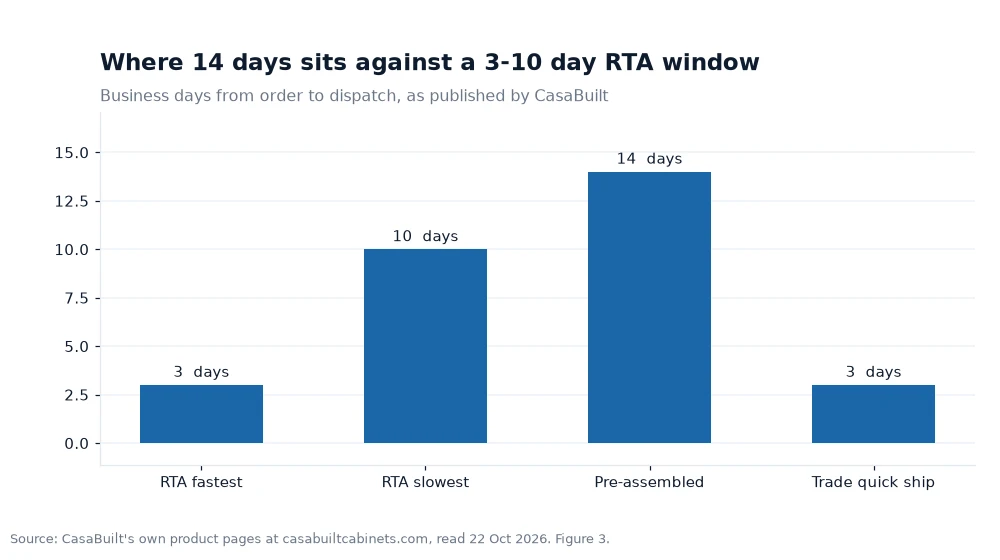
The chart plots four published figures. RTA fastest is 3 days, RTA slowest is 10 days, pre-assembled is 14 days and trade quick ship is 3 days. The gap between pre-assembled and the slow end of the flat-pack window is 14 minus 10, or 4 days. The gap between pre-assembled and the fast end is 14 minus 3, or 11 days. The flat-pack window itself spans 10 minus 3, or 7 days.
Put those differences on a calendar for a job that must be closed in three weeks. If the order goes in on a Monday and the flat-pack lands at the slow end, ten business days is two working weeks. Pre-assembled at 14 days is three calendar weeks if the quote means calendar days, which is why the outer edge matters: a four-day gap at dispatch becomes a week of lost installation time once weekends and transit are added.
Trade quick ship is the outlier. At 3 days or less it matches the fastest flat-pack figure, so a trade buyer with a handover date can keep the flat-pack price and still compress the schedule, provided the order qualifies for the program.
Frequently asked questions
Do pre-assembled cabinets cost more than flat-pack?
The site publishes sale prices for the flat-pack lines, including a basic six-cabinet kitchen at $1,199.50 in White Shaker and $2,295.64 in Slim White Oak. Pre-assembled cabinets are listed as a separate collection, so the honest comparison is a like-for-like quote rather than an assumed premium. Add the value of the assembly hours you would otherwise spend.
Can I mix flat-pack and pre-assembled cabinets in one kitchen?
Mixing is a scheduling decision more than a product one. The two routes carry different dispatch windows, so a combined order can arrive in two drops. Keep the same door style and finish across both, and plan the install around the slower drop so a missing cabinet does not hold up the countertop template.
How long does assembly take on a flat-pack cabinet?
CasaBuilt does not publish an assembly time per cabinet, and any figure quoted by a seller should be treated as an estimate. What is published is the kit contents: flat panels, all hardware, step-by-step guides, assembly videos and support. Budget a full day for a small kitchen and two people for the wall cabinets during installation.
Choose the route by the date, then by the labor
Write the install date on a calendar and count backward. If the resulting order date falls inside the flat-pack window, take the flat-pack route and book a helper for assembly. If it falls inside the two-week pre-assembled window and nobody in the house can give up a weekend, pay for the assembled boxes.
Then confirm the small things that decide whether the plan survives: the delivery address can take a pallet, the stairwell can take an assembled box, and the order clears the $2,500 free-shipping line. The route matters less than the schedule it has to fit.
Figures quoted here come from the manufacturer's own website, read 22 Oct 2026[1].